
Thursday, June 24, 2010
Monday, May 24, 2010
Warming Up to Book End

In conversation, the idea to book end a fairly substantial training week with two races sounded beneficial and somewhat do-able. As I attempt to increase my speed and power in all three disciplines of a triathlon, races are opportunities worth my effort and there were two on the cycling and triathlon local schedules at opposite ends of a training camp – dEVa Warp Speed Time Trial (May 9th) and Oliver Triathlon (May 16th).
On May 9th, Britni Bakk and myself signed on for the 20km Individual Time Trial race held in Abbotsford, BC. The roadie scene is very different than the triathlon scene. Road cycling race organizers and riders as far more casual and somewhat unorganized when it comes to coordinating registration, start times and send offs. It became very clear to us that we had ample time (hours!) to warm up and prepare our bodies and our minds for our 20 km time trial.
With a new Playlist downloaded onto my iPod and a structured 45-minute warm up specific to the effort to come, I arrived at the start line more than ready to execute 20 kilometers of effort. It was an assuring feeling that I was not anticipating to experience. After crossing the finish line and allowing my heart rate and breathing to return to a normal state, I realized how grateful I was for the effective warm up and how much it must have helped me execute a near flawless 20km time trial despite my recent training load and complete lack of taper for this race.
My average heart rate for the race was 172, my time was 29:46 and my average speed was approximately 39kph. I placed 2nd in the Cat 1 Elite Female riders division. Y warm up consisted of: 20 minutes endurance easy spinning @ 85-95 rpm – 10 minutes tempo effort progressing from easy to steady state – 2 minutes easy recovery – 6 minutes ramping up steady state effort to just below lactate threshold – 2 minutes recovery – 2 minutes of 105 rpm above lactate threshold to produce, buffer and clear lactate – 2 minuets recovery – 2 minutes of 105 rpm above lactate threshold to produce, buffer and clear lactate and 2 minutes easy. What was interesting was the process of feeling heavy legged at the outset to open and supple at the completion of the warm up. Note to self.
It can feel disconcerting sometimes when an athlete begins a warm up and feels lethargic and fatigued. I am guilty of always wanting to feel great before a training session or race. Rarely do I feel spunky, light and fresh before an event if scheduled as a “training opportunity” instead of an A race. It takes mental focus and calming thoughts to remind myself that my fitness is within and race pace effort is available if properly prepared before the start line. Such was the case at the dEVa Time Trial.
The very next day, Britni and I loaded my car and drive south to Coeur D’Alene, Idaho for 5 days of training on the Ironman Coeur D’Alene course. While her focus is the Ironman distance and mine is the half-ironman distance, we coordinated our schedules to train together 90% of the time. We compounded four big rides with short runs, pool swims, early nights and movie watching. Coach Paul was checking daily to keep me focused on the bigger plan as well as sending reminders about where I needed to be mentally – focused, calm and uncluttered. He and I had some of the best coach-athlete correspondence during my week away.
Two great quotes he sent me will surely resonate with more than a few people out there (if not, I envy you):
"The sum of a man's problems come from his inability to be alone in a silent room."
Blaise Pascal
"Doing nothing is better than being busy doing nothing."
Lao Tzu
Just as Britni and I were finding out groove and seeking out all the great spots to train, it was time to pack the car and head north-east to Oliver, BC for another speed and power seeking opportunity – The Oliver Triathlon, Sunday, May 16th (Olympic & Sprint distances). This is where things got interesting…
We were both feeling energized and confident from the past few days of quality training. Sunday’s race seemed ages away. Waking on Saturday was a different story altogether. This was our supposedly “taper” day - the day we cocoon, rest, eat, nap and recover from the training. No such luck. We were facing a four-hour drive, registration, race preparation and new hotel. Our bodies were rejecting these demands and craving a deep tissue massage and protein shake. The only salvation was that we were in it together and could encourage one another along the way.
Once back in Canada and within cell phone range, we called Coach Paul on the in-car Stereo System Bluetooth to discuss a pre-race plan. We really wanted him to know just how lethargic we were feeling and how this idea to book-end a training camp with two races may not have been the best idea after all. Paul would have none of such chatter and forcefully encouraged us to get out for a ride and wake up our bodies before they went into hibernation mode. We needed to keep the blood flowing to our muscles and get our heads prepared to endure the discomfort coming our way in 24 hours. I can say for certainty that there was no way I was planning to ride had we not spoken to Paul. Movement of any sort was not a welcomed concept. We did as we were told and both felt better after a spin and conceded that it was the best thing we could have done.
The second major coaching guidance Paul gave us (me especially) was to get in a solid 45 minute warm up before the race. My internal voice said, “ 45 minutes? Are you kidding me? That’s almost a workout?!” Paul could hear the lethargy in my voice and needed me to understand the importance of revving my engine before the race. It was the only way to get the body and mind where they needed to be after such a big training week and long drive. He said it was essential that all the muscles were firing and blood was flowing before the gun went off.
So there I went, an hour before the start, rolling along the racecourse on my Specialized Transition bundled in my warm up clothes attempting to find the Zone during a 25 minutes spin. As racers were filing into transition and the energy was mounting, I had enough time for a jaunt and really get that warm and fuzzy feeling. I sprinkled in a few striders and drills but nothing felt remotely pleasing or reassuring. I found myself asking, “What else do I have in my mental tool kit to muster up a fiery aura?” The answer: Autopilot Mode.
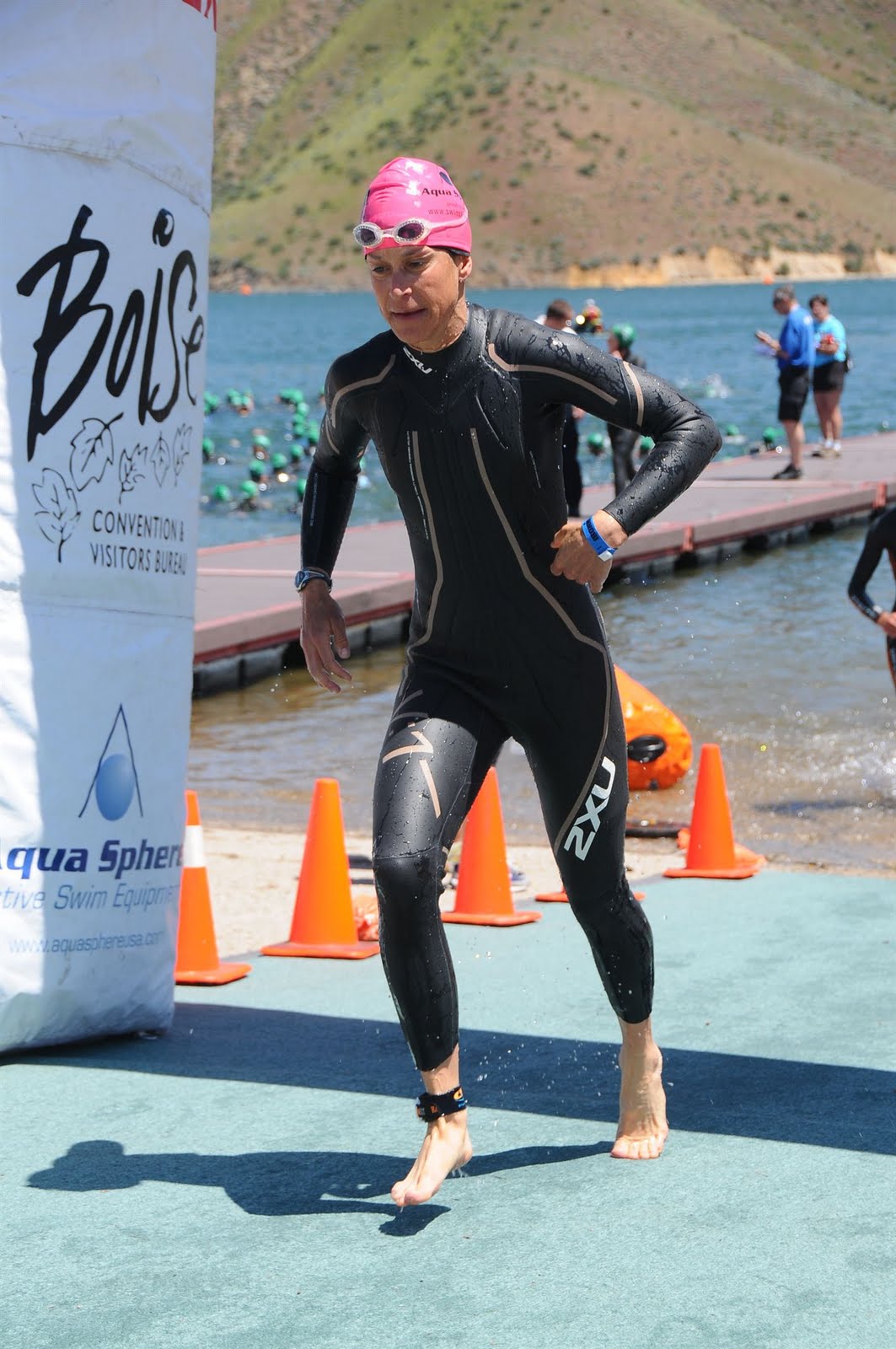
Once suited up in my wetsuit and seeded amongst an aggressive group of male triathletes, I flicked the “Autopilot” switched and let any thoughts or judgments fall by the wayside. Anything other than purity was worthless to me. Yes, it would hurt. Yes, it would be uncomfortable. Yes, the “fun” part comes after the finish line. Now was not the time to think. Now was the time to GO HARD and focus on the present moment. Now was the time to go Autopilot. Seems to work every time.
All 300+ athletes swam 1.5 k, biked 40k and ran 10k with best efforts and gratitude for being able to test our fitness and challenge ourselves. Crossing the finish line in two hours and fifteen minutes, I knew gave my best effort and found a rhythm, a flow and the fiery pulse I was after that morning. The bonus of the day was finishing a first female in the Olympic Distance and Britni finishing 2nd in the Sprint Distance race. She and I bonded instantly over our mutual satisfaction that we can now really call it a wrap and focus on recovering from the last 7 days…right after our 5-hour drive home.
Coming back to the beginning of this tale, it turns out it was a good idea to book end our training camp with races and the results were a bonus. But the real lesson was realizing that preparation for both races and the training session were my salvation. Firstly, Paul had my training very well laid out prior to my travelling dates so I was mentally prepared for the hours and efforts ahead. Secondly, my warm ups before the races and each session made a tremendous difference to every performance.
My understanding of an effective warm up (with or without lingering fatigue) has shifted significantly. I now understand the importance of truly preparing for the main event. No one is excluded from the benefits of a proper warm up. If slowly increasing blood flow to muscles, opening capillaries and increased body temperature means more oxygen is being delivered to the muscles and better performance while exercising, lets all sign up for this protocol. Studies also show that a proper warm also prepares our minds for the upcoming work and in turn improves technique, skill and coordination. We ready ourselves for discomfort and offer up the willingness to endure the energy expenditure. If the mind is willing the body will follow.
The whole idea is to get an edge. Sometimes it takes just a little extra something to get that edge, but you have to have it. If it means adding a proper warm up to your protocol, it’s a small sacrifice for a significant edge.
Christine
Sunday, May 2, 2010
Free Speed - May 1st, 2010
My massage therapist believes we carry our “stuff” in our bodies: hips, shoulders, jaw, stomach and ankles. I admit that she has the uncanny ability to ask seemingly unrelated yet accurate questions to the fairly straightforward reason why I am visiting her. “How’s your communication with others these days?” or “Is there something you are not talking about with a loved one?” Is she suggesting that I am controlling my life by thrusting my shoulders up to my ears, clenching my jaw and holding my torso taut, which inevitably results in compensations elsewhere? Am I working through any emotional crisis with my hamstring glute attachment? Perhaps, but surely my muscles are not only tight because of unresolved emotional issues in my life. Surely my weekly training hours have something to do with the restriction in my hips. Surely.It’s like when my yoga instructor is twisted into a pretzel, breathing calmly and giving methodical instructions to follow suit, I think to myself, “Now there’s a demonstration of authentic control and true freedom with mind and body.” My next thought (isn’t my mind supposed to be quiet?) shifts to the diligent practice she maintains on a daily or hourly basis, leading to body awareness, serenity, freedom and power…traits we all aspire to embody. Interestingly, to possess such admirable traits doesn’t cost a dime. It’s free.
Where is this all going? Allow me to explain. Of late, I have been exploring how to gain more flexibility in my body (and hopefully my mind) so that I can tap into a wider range of motion and carry on in life with a poised posture and long healthy limbs. My body (or is it my mind?) likes to hold tension in the front of my shoulders and chest area (pectoral muscles), my hip flexors, my hamstrings and my glutes (actually it is my piriformis but who needs technical terms?). During infrequent moments of muscular release I experience newfound freedom and what I call “free speed” in swimming, biking, running and in life. It is no different than when we watch children play. We admire their multi-directional freedom and Gumby-like agility. They can butt kick like no adult I know. Maybe this level of nimbleness will never return in its entirety but we can certainly improve flexibility, range of motion and reach with functional practice.
With my new focus on Half Ironman distance, I need more speed to be competitive with the pro field. Girls are running low 1:20’s off the bike and closing the gap on many pro men. My coach, Paul Cross, has astutely reduced the density in my workouts and increased the emphasis on speed, strength and quality efforts to address this need. Long gone are the 6-hour LSD bike rides with a 45-minute run, thick swim workouts and diesel engine runs. Instead, you will find me working the 50’s in the pool with some drills before and after, hammering out short stints of 15 seconds to 10 minutes on my computrainer (in my garage) or at the track learning how to execute a few fast 400’s.
Racing is often the best way to tap into our upper effort levels and gain a step up in fitness. Upping my fitness is always something I will look for. As luck would have it, my schedule allowed me to jump into in a half marathon race in Montreal, Quebec (April 19th) as well as a Sprint Triathlon in Delta, BC on (April 24th) for quality speed sessions. My half marathon was two minutes off my PR with a time of 1:25 and first-place finish in my division. The Sprint Triathlon was also a success with an overall win. Both experiences had me working uncomfortably hard and inspired me to ponder the concept “Free Speed.” It may sound like a short cut but once you understand the concept, it is the smartest way to get faster.
No one better to bring this up with than Coach Paul Cross (PC). PC and I discussed “Free Speed” at length, what exactly the term meant and whether it was a worthy pursuit. We know that my training will continue to focus on upper threshold workouts and develop new energy systems, neither of which is “free.” In fact, training in and of itself is costly in terms of recovery, fatigue, time and effort. So, where else do we go for low-cost gains? Where does Free Speed come from? Likely many places but in my case, Efficiency in Form & Equipment Fit & Function.
Efficiency in Form. Could it be that efficient form equates to a more powerful movement pattern? Could it be that efficient form requires flexibility, range of motion and body awareness? Does this mean we need to slow down to learn form in order to speed up once habituated? Could it be that when fitness and form come together, we gain “Free Speed”? Who knew? Free speed doesn’t come from fitness, it comes from efficiency in form. As we move through our activities with less energy demand, we will eventually move faster after practice and integration. We use gravity and our amazing levers to execute a movement pattern that is sleek and functional.
Equipment Fit & Function. In triathlon, the bike leg can make or break your race. It is typically the longest segment of the race and also sets us up for the run. Being at one with the bike is critical. Being positioned comfortably with optimal angles, heights, bends and reach is essential for your bike and run legs. Optimal positioning on the bike definitely equates to “Free Speed.” Again, no fitness gains required.
The Free Speed Execution Plan
In order to put these revelations into practice, PC and I are devising a Free Speed Execution Plan. For starters we are meeting at the track on a weekly basis for some drill work and video analysis. We are fine-tuning my “lean,” knee drive, toe-off and arm swing. Did you know that a proper lean in running is free speed? Did you know that having your elbows at 90 degrees or less is free speed? The list goes on and on.
We are also spending endless hours in my garage tweaking my bike fit for maximum power recruitment coupled with optimal comfort and aerodynamics. We discovered a small shift in saddle height (up) and aft adjustment resulted in dramatic output gains. We shortened the reach to the aero bars, which reduced tension in my arms and upper back. Any newbie would know this equals Free Speed.
I’ll share a link to a video analysis of my run and PC’s comments.
http://www.upmygame.com/watchv/3546/0/
In an email to me, PC writes: “you need more hip flexor range of motion... which... affects the forward swing phase... which affects your angle of attack... which affects your foot strike and makes you have a heel strike...as a result...you're running as a quad dominant runner... rather than really using your hamstrings and gluts to their full potential...” As I pulled myself out of the gutter, he writes “don't get me wrong...you are running great now compared to where you were...and that's all we can ask really...I think most of these gains have come from fitness and training... perhaps 70%... and the other 30% from improved technique/form...so it's actually good news...because you have a good amount of potential to still go in terms of your form...” Phew. I was almost over the edge. And I know that all the little tweaks in form and function are free speed.
Who doesn’t like free stuff?
This is an exciting phase in my athletic career with gratifying workouts and recorded fitness gains. The Free Speed tweaks will not be the only reason for any further progress in my fitness but it’s nice to have a few deposits for just showing up.
Christine
Saturday, March 27, 2010
California 70.3 (March 27th 2010) It's All About the Swim
Spending any length of time in Carlsbad, San Diego is a seductive and surreal experience. As I rolled along the Pacific Ocean during a few final pre-race prep rides watching hundreds of surfers hop out of their pick-up trucks with their boards neatly tucked under their armpits, sporting muscular defining wetsuits on their sleek bodies, letting their shaggy bleach blond hair bounce freely and “BFR” (bare foot run) to join the other neoprene floating angels already waiting for the Wave, I asked myself, “Is this life real? Is this kind of perfection in weather, fitness options, lifestyle options, yuppie treats, free spirits, and glorious views conducive to living a purposeful and productive life with both feet planted firmly on the ground? Don’t we need to suffer more before we deserve such luxury and good fortune day in day out?” I would hazard to guess many of those surfer-dudes don’t spend an ounce of energy weighing their worth prior to enjoying a good wave. Note to Self, I say. Write it in pen: “Live the Moment, Focus on Now, Life is a Journey not a Destination.” I hate clichés. But all too often, they hold truth and power and I must confess, I used them all day long on Saturday, March 27th.
With the guidance offered by Bobby McGee’s book “Magical Running” (as summarized in my last Blog entry), I was feeling anchored, prepared and keyed up for Saturday. Britni Bakk and her husband, Warren, were my travel partners. Britni was racing in the 40-44 age group and gunning for a Kona slot. Her chances were almost 100% based on her exceptional fitness and track record at Oceanside. I was equally anxious to see her race and hopefully celebrate her journey to Kona. Britni and I have spent so much time together training and traveling to races that we calm, encourage and inspire each other. We bring out the best performances possible in one another and freely share our experiences, good or educational. Warren is the rock in her life (and visa versa) and serves as mine too during our racing excursions. Being in their company is always energized with laughs and respect. Their companionship made my experience and ability to hone my mental focus possible. One only hopes to return an ounce of such generosity.
With our prompt arrival at 5:00 a.m. on race morning, we witnessed athletes streaming into transition like a party was about to start. The announcer was promising a pristine day of sunshine, a cool ocean swim and a high of 73F by midday. My focused was on my bike set up, body marking, warming up and peeling on my wetsuit in good time for our 6:43 a.m. swim start.
Like cattle to the trough, the Women Pro were called to the start and allowed to enter by 6:37 for a warm up. Warm up? Warm up in 58F water? No thanks. Myself, Sam McGlone, Michellie Jones and Leanda Cave smartly conserved our body heat and waited until the last second to splash towards the start line some 200 meters away. Even then we had 2:00 minutes to tread water in anticipation. I found a nifty position (after visualizing my speedy start for the past 24 hours) right on Sam’s heels and only assumed I would stay with her for the entire swim. No such luck. I’ll need to visualize harder next time and gotta-wanna even more. Within the first 400 meters, the pack was split and I found myself in a pack of five swimmers. My stroke felt fast, strong and efficient through the water but upon exiting I glanced at the clock and saw that my time was the same as previous years. It’s all about the start in these swim. Note to Self.
California 70.3’s transition is no short jaunt. From the shore to our gear, the athletes run half a km down and back through the 2,500 racked bikes. If all goes well, you will re-establish some sense of equilibrium by the time you are ready to mount your bike. I was aiming for a sub 3:00 min transition time. Final time: 3:05. Darn wetsuit cuff was glued to my calf and those extra tugs cost a few precious seconds.
Triathletes, runners, and cyclists participating in races are blessed with a guided tour through beautiful landscapes and roads completely uninhibited by traffic. The California 70.3 race is rich in history with its surrounding communities and prides itself on a well-established relationship with Marine Corps Base Camp Pendleton and its Officers. The bike course loops through and around the Base Camp into areas normally close to public access. The course is technical and curvy for the first 40 miles then rolls over 3 major hills before a long flat straight-away back to the harbor and T2. My new Specialized Transition Pro was performing well. As the operator, I felt in control and strong, focused on efficiency and maintaining exceptional aerodynamics. Together, we worked hard to make up five minutes and pull into the lead group of gals. We bettered our time by one minute from last year having ridden the best we could after a solid winter of indoor riding and enduring minor distractions from small events such as the Winter 2010 Olympic Games in our hometown, Vancouver, BC. Our best effort was put forward and that was all we could ask for. We agreed to work on strength and power and use this as benchmark for more quality training and measurable improvements.
Coming into T2, the sun was beaming bright and we were in for a glorious sun-baked half marathon. Again, it is a country mile down and back through transition as we awkwardly run beside our misbehaving bikes with our clipped in shoes flailing around uncontrollably. As planned, my T2 was lightening fast. A quick yank of the racing flats sans bas (a trial) and I was over the timing mat in under 1:45 minutes. My first two miles felt light and quick – under 6:50 min/miles, but I knew a pit stop was in my near future. It was not urgent but it was necessary. Come mile three I dashed off course to make things right. While doing so, I surrendered two spots and only assumed I would make them back and more. With waves of strong energy, great rhythm and a high stride rate, I was covering some ground. I reeled in a few of the very fast swimmers and cyclists but not as many as I would have liked. Thanks to the winter strength work, my run form and carriage felt more in tact than in previous races. Coming into the last two miles, pain crept into every muscle fiber and cell. The exertion had caught up to me, physically and emotionally. No amount of Gatorade, Coke, Gel or cheering crowds would reverse my desire to end this effort and output. The final turn towards the finish line is always bittersweet. This time was no different. Sprint to finish. Pain to Glory.
My time was 4:47. 14th Female Pro. A personal PB at California by 7 minutes. An excellent benchmark for an early season effort. Best of all, my race execution went as planned with the exception of finding faster feet in the swim. My mind was focused and clear of clutter. My focus was narrow and directed at getting to the finish line as fast as my best effort possibly could. It’s a good feeling to finish a goal race knowing that you gave it your all and that, come next time, performance improvements are possible based on more practice, more awareness and the lessons taken from the previous experiences.
Britni was second in her Age Group (40-44) and snatched an Ironman Coeur D’Alene spot where she’ll undoubtedly qualify for Kona. She and I plan to spend a few days in Coeur D’Alene this Spring to ride the course and get her dialed for a solid Ironman race on June 22nd. Next on my race calendar is a half marathon in Montreal on April 18th, followed by a sprint Duathlon in Penticton on May 8th. These shorter races are geared to improve my speed and power. We’ll compliment these races with strength session and specific functional muscular recruitment drills (need a dictionary? I did.) We’re planning for PB’s all season long.
Christine
Sunday, March 21, 2010
Visualizing Magical Experiences

It is one week out from the first race of the season, California Ironman 70.3. This large scale WTC event takes place in Oceanside, San Diego, routing the 2,000+ lucky racers along the Pacific Ocean Coast and through Camp Pendleton Navy Base (otherwise not open to public). This will be my fourth year racing at Oceanside but my first year with more specific half ironman fitness. Every year is a new experience but two aspects seem to remain constants: the ocean water is salty and crossing the finish line is forever gratifying (I can already taste and feel both…).
In my lead up to this race as well as in preparation for my season and half ironman racing goals, I was encouraged to revisit the mental aspects of my training and plunge a little deeper into this crucial and equally important component of racing and performance. It took little persuasion for me to delve in.
However, when you have not been doing something (aka: relaxation therapy, visualization, etc) on a conscious level with time set aside to specifically focus, it can be a minor hurdle to begin the process and to even know what is the first step. It’s so easy to procrastinate and find other things to do in place of mediation and writing out thoughts, feelings, sensations and experiences. All this stuff requires a presence, an “in the moment” mentality and deep look inside stirring around for all that needs attention. Who wants it? But, as I have recently noted, crawling through this tunnel towards the dim light at the other end is an interesting journey and warrants much more regular attention. Plus, they say it gets easier with practice and much less daunting.
Of late, my favorite reference for mental preparation and conditioning is Bobby McGee’s “Magical Running” (www.bobbymcgee.org) Even though it mainly focuses on the running experience, it can be applied to any sport, most easily triathlon. It takes the form of a progressive workbook dedicated to the magical experience (spiritual, emotional, mental and physical) of running and performance execution. Bobby emphasizes the process with little to no emphasis on the outcome or results. He teaches us to prepare the mind and thus the body for an ideal performance state prior to any training session or race.
The Chapter that gripped my attention, being seven days away from a race, is “Visualized Running, Seeing Yourself Run and Race Successfully.” Very simply put, visualization is to “see” how you achieve dream levels of sport by imagining the performance through the use of all your senses.
Bobby quotes some wonderful excerpts from top-level athletes. One in particular made the hair on my arms stand straight up. Bruce Fordyve, 9-time winner of the Comrades marathon (South Africa), shares, “So, two weeks before race day, I saw myself on 45th Cutting (a steep 5 mile hill to finish). I planned to strike there and get away from any pursuers. In my mind I pictured, heard and smelt the car exhaust fumes, the crusty sweat of my cheeks, sore stiff legs. I could hear the hysterical yelling from the crowds lining the narrow corridor that remained for the runners. I visualized what was required. What I imagined was an almost imperceptible but smooth increase in pace, the faltering of my pursuers and the gradual realization that I had stretched and then snapped the umbilical chord between myself and the rest of the field. On race day, an eerie déjà vu swept over me. I had been there before, it was happening just as I had planned it.”
Clearly Bruce had played this movie many times before in his mind. He planned for the feeling, sight, sounds, taste and touch of each move. He credits much of his victories to his mental preparation and successful visual cues and sensations.
Bobby outlines the key points for visualization:
· Visualize in the past tense. Believe you have already achieved the performance.
· Focus on action and process, not outcome. Flow, efficiency, balance, coordination, effortless, relaxed, rhythmical, etc.
· Form a routine to practice visualization (x minutes / week).
· Aim high and be realistic.
· Visualize in real time. If visualizing a mile, take the time to visualize every step of the mile. It may take x minutes to complete the exercise depending on how fast you want to run the mile.
· Always “see” success. Expect the best, prepare for the worst.
· Visualize from your true vantage point: inside yourself. Be the participant, not the spectator.
When I have successfully used visualization before past races, using all my senses has proven to be a very effective way to ensure that come race day, the experience is familiar. And don’t we all like familiar? Smell, taste, touch, sight and sound are equally influencing our minds and physiological response to potentially high stress circumstances. The smell of suntan lotion on the athletes in transition, the taste of my sports drink, the feel of the water temperature or light morning breeze, the sight of spectators, officials and athletes during the last lap of the run, the sound of the announcer’s encouraging voice coming through transition. If you play this movie over and over, come race day, you’ve seen it before through a positive, successful and familiar lens.
The Visualization Chapter also covers the process of clearing or de-cluttering the mind to perform, a step that many people many overlook not realizing how distracted they are with “stuff” in the life – bills, responsibilities, duties, etc. Various techniques are used to clear the mind and find focus for the task at hand. For example, you may share with trusted individuals who will listen unconditionally and/or you may list very specific responsibilities that you need to get done in the future and promise yourself to return to this list as soon as the task at hand is accomplished. The result is gaining control of your thoughts and creating calmness and space to unveil the performance for which you are prepared.
As goal driven athletes, we typically have lots going on in our minds and only feel gratified by doing something (or many things). Clearing the mind is a skill that requires practice similar to pedaling a bike, swimming a stroke or running a step. Note to self…
So in my last seven days before the race, I’ll be visualizing a successful race in California, tapping into all my senses and becoming more and more familiar with the movie that will play next Sunday. Of course, defusing past experiences (in the event they were negative) and removing any resistances are essential steps in the visualization process. Recognizing that the past is over and letting go is absolutely necessary to move forward with new and positive thoughts. With this freedom, the mind is allowed and open to focus on the race, the goals and the pre-recorded movie about a successful performance.
I’ll finish by sharing one more quote by Bobby in an article he wrote on his Blog called, “Effective Mental Training”. He says, “Self confidence comes not from success, but from an intimate knowledge of your own ability and being able to access that ability whenever you choose to.” Re-read this quote a few times and it will settle in with your true self and a renewed perspective on how great you are as an athlete and individual.
Christine
www.christinefletcher.com
Saturday, February 6, 2010
The Athletes Come to Town
I, officially, have the Olympic fever. In six short days, Vancouver and Whistler will welcome over 2,200 of our world’s finest “winter sports” athletes to compete in the 2010 Winter Olympic Games. Despite knowing for a few years that Vancouver won the Bid, it has only been in the past few weeks that my own proximity (and accessibility) to this once in a lifetime event has begun to resonate. With little effort, I find myself trying to absorb every Olympic-related publication, news report, Pod cast and TV show highlighting athletes, the sports and ongoing celebrations.
It’s not like I ever dreamed of being an Olympian or obsessed over a specific Olympic sport or athlete. I am in awe of some pivotal athletes that broke world records, overcame adversity and performed under the microscopic eyes of millions upon millions spectators. And even more awe striking are those that crashed out on their one chance and were forced to prepare for another four years to showcase their finely tuned skills and athleticism.
I’d be at it all day if listing all the Olympic moments that we Canadians may be most proud of. I can name two more recent athletes that have impressed us and stolen our hearts: Cindy Klassen and Clara Hughes. Cindy (Speed Skater) won five!! medals in Turin and another one at Salt Lake establishing a new career record for a Canadian. Clara’s versatility, or should I say seasonality, is beyond astonishing (she owns two bronze medals for cycling from 1996 and a bronze, silver and gold for speed skating from 2000). David Pelletier and Jamie Sale’s composure during the Russian judging scandal in Salt Lake 2002 when they were forced to share a gold medal showed their true love for skating and ability to rise above. I’d be remised not to mention the likes of Elisabeth Manley, Nancy Greene, Eddie the Eagle, Ken Read, Catorina Le May Doan and our Hockey Team. From a Canadian perspective, these athletes (and teams) have instilled rich Olympics memories in all of our hearts.
Luge, Skeleton and Bobsledding are three events that mystifying me. While worthy of serious respect, I know very little of the science, training or aerodynamic detail that goes into an Olympic performance (and I imagine it’ll stay that way for a while). I do know, however, that the Germanys have the Luge figured out and they’ll be one to watch in a couple of weeks. I have yet to watch the movie about the Jamaican Bobsledding team, Cool Running, but maybe that’d be a good place to start. I also steer clear of curling but I bet if I were from Winnipeg, I’d feel differently. Since I am not, I’ll stick to my favorites: Alpine or Nordic Skiing (cross, combined, biathlon, jumping, or freestyle) and Speed Skating (short track or long track) will have my undivided attention. I’ll tune into Hockey and perhaps some Ice Skating. Regardless, forever will I be awed by all the athletes and their dedication to arrive healthy and motivated for a chance of a lifetime performance and experience in the great venue.
For interest, I’ll share whom (Canadians) I am watching in 2010:
Nordic Skiing: Chandra Crawford, Alex Harvey, Devon Kershaw, and Sara Renner.
Long Track Speed Skating: Kristina Groves, Clara Hughes, Cindy Klassen, Christine Nesbitt, and Jeremy Wotherspoon.
Alpine Skiing: Emily Brydon, Robbie Dixon, Erik Guay, and Britt Janyk
Honorable mentions:
Ice Skating: Patrick Chan (who else?)
Nordic Skiing: Brian McKeever (the four-time gold medalist from the 2002 and 2006 Paralympics will become the first winter-sport athlete to compete in both the Olympic and Paralympic Games). Amazing.
Last year when I raced the Ironman in Lake Placid, New York, it gave me a taste of what’s to come. The IM transitions (Swim to Bike and Bike to Run) and finish line were staged on the 1932 & 1980 Speed Skating Oval (outside in those days) and graced us with unforgettable views of the Ski Jump and Alpine venues. Seventy-Seven years later, the shops were still selling Olympic logo-ed merchandise, including some Vancouver 2010 logo-ed swag. Now that the Games are upon Vancouver and Whistler, what we have been anticipating is quickly becoming a reality. The stages are set: the snow, tracks, jumps, ice rinks, ovals, slides, and half pipes are ready for the best of the best to grace their surfaces with skill and finesse.
In my feverish state, I did some reading on stats. Did you know Canada has won 119 Winter Olympic Medals (38 Gold, 38 Silver and 43 Bronze)? I didn’t. The Soviets have own 1,204 just to put things in perspective. Norway rocks across the board owning more Winter Olympic medals than any other country. Canada is the only country to host two Olympic Games (1976 in Montreal and 1988 in Calgary) and not win a gold medal. I have faith Canada will walk away with more than a few gold medals’ this February.
I ask myself why I caught the fever? Why am I so taken with the onslaught of elite athletes and the performances we will soon witness in our backyards? Why am I a student of the 2010 Games like no other Games before? Perhaps as I mature as an individual and also a professional athlete in my own right, a healthy sense of curiosity has evolved inside to learn more about these Olympians and how they channel their passion and focus on their goal. When I read their stories, I think about their journey as an athlete and how they prepared day in and day out to finally be on the start line, much like I do to prepare for my sport. I think about how they were supported by friends, family, coaches, and therapists to make this experience a reality. Each story, no matter the sport, gives hope and inspiration. It offers possibility and belief in dreams becoming a reality. It doesn’t have to be the Olympics. It can be as small as running one block. No matter the person, goal or sport, it is relative and something we, all of us, can relate to.
The other day in the pool, I witnessed a performance that impressed me. I call it a performance because it was just that. Even though it was just at an early morning swim practice, it was still a performance. Our lane is comprised of a couple exceptional swimmers breaking water for a few drafters. The most exceptional swimmer (high level athlete, coach and confident individual) normally leads out the lane and we all follow either a respectable ten seconds behind (five, if you need a draft). On this particular day, our trusted leader was exceptionally tired. I could tell by his body language that he was hoping for a casual swim. Unfortunately, he was being tailed by the second person by two seconds (hardly respectable distance) who was easier riding in his wake the entire swim practice. My admiration for our leader surfaced when I observed how calm and collected he remained. He stayed the course, executed the workout impeccably and dug for energy, strength and focus till the last bitter length. Despite an incredibly arrogant follower showcasing his ego by swimming on his feet, there was not a dent in our leaders armor. Sounds trite to retell the story but in fact it was the epitome of executing a performance under stress and pressure. I suspect we will witness a few solid performances during the Games where focus and boundaries will be of utmost importance.
And so when the Games arrive and I either attend or watch on TV, I’ll be watching for the subtle expressions on the athlete’s faces, their pre-race preparation, their ability to overcome adversity or react to less than ideal situation. I’ll be watching them celebrate their victories and revel in the joy of accomplishment. I’ll be watching the athletes interact with their competition and how they respect each other, their country and their support networks. As an athlete myself, I will relate to them on some level and hopefully integrate some of what impresses me about them.
Go Canada Go
Saturday, November 7, 2009
Longhorn Ironman 70.3 - final race of the season
Pre-Race Adventures
As I sat on the airplane on my way to Austin, Texas three days before my final race of the season, I thought to my self, “what on earth am I doing flying to Austin to swim, bike and run?” Lugging my bike box, racking up grossly overpriced excess baggage fees, navigating my way through a new city in a rental vehicle and sleeping on thin hotel sheets seemed a far cry from what I really felt like doing which was to stay home in the comforts of my routine and well-defined schedule. It took mere minutes to flip my cynical and ponderous attitude on its head upon my arrival into the Austin airport and experience the welcoming openness of this great city, home of the Texas Longhorns and USA capital of live music.
Just two days before leaving for Austin, my travel partner and Professional Triathlete, Sara Gross, bowed out of coming due to a flu bug that wasn’t letting up. Sara is going on to race Ironman Arizona in a few weeks time so she felt no need to drain herself in the Longhorn experience. While I missed her company for the travel, I settled into nomadic mode and explored the town with vigor.
Day One was an unplanned excursion day as I attempted to get oriented and familiar with the landscape and climate. My first stop was Jack & Adams Cycles, a local’s shop for triathlon gear, nutrition products, and great service. Just around the corner were two more enormous cycling and triathlon stores nestled in between “Austin Java” and funky bistros. I was encouraged to explore the famous quarter mile spring fed Barton Springs Pool in Zilker Park a quick mile away from Jack & Adams (on Barton Spring Avenue). My eyes deceived me when I rode up to this enormous quasi-canal-like-pool with Lifeguard chairs and distance markers. Apparently, this was the training pond for local triathletes and long-distance swimmers. Next visit, I’ll be sure to go for a 4-lap splash just to say I swam a mile in Barton Springs Pool.
After a short run along the Barton Town Trail, also popular route to the svelte and fit, young and old neighborhood prancing along with their dogs or comrades, I GPS’ed my way to Luedecke Arena and Walter E. Long Lake for race registration and a tour of the transition site. Longhorn Ironman is organized by EndorFUN (Race Director, Keith Jordan). This company is now the event organizers for three more 70.3’s – Timberman, Mooseman, and Lone Star. After experiencing the organization of EndorFUN, the preparatory information, and coordination of logistics, along with the fact that the 70.3 (half Ironman distance) is a distance I am embracing as my main focus, I hope to schedule more of EndorFUN races into my season. As I said to Keith Jordan, his recruitment of enthusiastic volunteer support, the unmistakable course markings, the offering of quality event merchandise, a seamless transition set up, and the race-day spirit should be the model for other race coordinators.
One Day Before Race:
Saturday involved a refreshing swim, smooth ride, and short jaunt from T1 (transition one) where I was in fine company of at least 1,000 athletes doing the similar yet slightly personalized routine. I kept to myself and reveled in eavesdropping on in-depth conversations about race day nutrition, pacing protocols, “lack of training” and declarations of doubt and fear, all the while justifying their presence with sentiments of encouragement and grounding inspiration.
The Pro Meeting was efficient and informative. The USAT Officials assured us there would be at least four motorbikes accompanying us all day to ensure fair riding for everyone. This was a relief since they were MIA - missing-in-action - in Augusta, a short month earlier.
By noon, the race day preparations were a rap. Amit Bhutani, my almost-homestay-local-triathlete-recoverying-from-shoulder-surgery-race-day-volunteer-facebook- expert-new-friend and overly hospitable generous soul and I toured the Expo prior to my navigating (albeit poorly) back to my dinky hotel room to rest and rejuvenate.
Dinner both Friday and Saturday night consisted of a football size baked sweet potato and a Texas grain fed 6oz filet mignon. The tank was topped up and race day would simply require a focused mind clear of any thought and judgment coupled with a rhythmic stroke, silky slipstream, and gazelle-like steps.
Race Day:
All 2500+ athletes along with equal number of supporters and volunteers were crowding into transition as early as 5:00 a.m. The Pro’s wave was at 7:30 a.m. with 4-minute intervals to follow by age group. Some sorry souls only started at 8:40 a.m. yet had to have their bikes set up, morning clothes dropped off and be cleared out of the transition barricades at 7:15 a.m. This meant many of them were standing around in a wetsuit for well over an hour waiting for their long anticipated wave start. Some people ask me why I choose to race professionally; an early start is definitely one of the reasons.
My “staging” area was dialed within 5 minutes. Check, check…bike racked, shoes in pedals, helmet, race belt and sunglasses resting on bars, gels and electrolytes secured to frame, bottles in cages, and odometer set to zero…check, check. With wavering confidence that my bike would remain unhampered or that my tires would mysteriously deflate, I committed to the next phase of pre-race preparations – put on swim cap, goggles, wetsuit, loosen up and narrow the minds eye prior to plunging in for a warm up.
Swim:
With 30 seconds to the start gun, the Pro field had drifted well over 30 meters ahead of the start buoys, with 10 seconds to go, we were uncontrollable and in full propulsion. Much to my amazement, I had a powerful no nonsense start and stuck close to the splashing and commotion of the main pack. My swim starts are an area of weakness yet I have been training to improve my explosive power “out of the gates.” Maybe it paid off? Let’s just pretend it did.
The swim course was marked with 10 foot red buoys in triangular formation. The course was unmistakable and if feeling strong, anyone could have had a good swim. Without relinquishing any effort, I successfully swam through a few packs before the final turn. With 750 meters remaining, I caught Terra Castro and stayed on her feet for the rest of the swim. A thick bed of weeds welcomed us back to shore. Time: 27:53. Followed by a steep grassy run up to the bikes, there was no time to contemplate life since I was determined to improve my transitions shift into bike mode as fast as I could. Time: 2:01 (well within the top pros).
Bike:
Once onto the bike, I put my head down and focused solely on the road ahead of me. The roads were a buffet of chip seal, cracked asphalt, and smooth pavement. There was opportunity to stay aero and fast yet the undulating hills allowed for diversity and an out of the saddle stretch. The pace was painful, the effort required solid focus, and double the calories I had planned for. Every time the sensation of “pain” or “discomfort” entered my conscious mind, I would self negotiate to acknowledge yet ignore the distress until after the race. Once through the finish line, I would give all the time and attention necessary to restore my body to homeostasis. This little bargain seemed to put the unnecessary at bay. With increasing frequency, I found myself pulling this ruse out for the last 10 miles of the ride and most of the 13-mile run.
With the exception of passing two other girls and being past by Kate Bevilaqua, nodding to the odd motorbike or photographer, and rolling through four aid stations, my two and a half hours were spent in my own company and the voice of a steady unrelenting mind. The course meandered through the rural roads of Austin’s farm country and formed an odd figure eight that never intersected. While I was not “magic on wheels,” I was motivated to dig for the strength I knew I had. I remembered thinking “I may as well kill myself trying before giving into the effort.” Kate and I pulled into T2 (transition two) side by side. Time: 2:28:51.
T2
In keeping with my “quick transition” goal, I didn’t even tie my laces up on my runners. I bolted out and stopped to tighten them once I ran over the timing mat. Time: 2:41 (the fastest time was only 20 seconds faster).
Run:
The party was on the 3-loop hilly run course. Runners were treated to live music, a sprinkling of cheerleaders, 18-themed aid stations (being one week prior to Halloween, there were no shortage of outrageous costume-clad volunteers), some grassy paths, some trail but mainly roads and ice cold towels every 3.5 miles. The heat and humidity was escalating and if I glimpsed down, I could see the salt crystals forming on the roundest part of cheeks. While likely not the salt from my cheeks, I knew this mineral would be a major ingredient in my post-race snack.
If nothing else, my focus was on maintaining a quick foot cadence, relaxing my shoulders and hands, and keeping tight angle in my elbows. Training with quicker steps has been a major theme of my practice runs for the past few months - counting and recounting my steps for 60 seconds, aiming for over 180. My highest cadence thus far, with great effort, had been 200 steps in one minute. I would be more than pleased with 184-188 steps per minute for race day. This would ensure efficiency and a speedier time than my 1:33 split in Augusta.
The level of discomfort was at an all-time high for most of the run. For the second and third loop, the age-group divisions poured onto the course. It was wonderful to have the company and share the effort with inspiring athletes. Given the distance of 70.3 miles and the time of approximately 4.5 hours, I was tapping into any and all fitness available. Gatorade, gels, water, and salt were guzzled at regular intervals. With about 200 meters to go, I was passed by another pro who found some great sprint in her step to finish a near 10 seconds up from me. I do recall trying to challenge the pass but surrendered when a greater effort resulted in the exact same speed. The Longhorn Finish line was inside the Arena with cheering crowds in the bleachers. Final Time: 4:29. A Personal Best at this distance. 9th Place Female Pro.
Nothing beats ending a season with nothing left other than motivation for a strong recovery and rejuvenation for next year. The Half Ironman distance has opened up a new level of enthusiasm for my racing career. When coupled with attending stupendously organized and spirited events, it makes the adventure much more satisfying.
Amit & Rad
My new friend Amit and his wife, Rad, collected me from my hotel that evening for a wonderful outing to a casual brewery serving over 100 imported and local ales. They wanted to take me somewhere more “interesting” and authentic than this place but I couldn’t have been happier right where we were. Since Austin is my new favorite destination, I’ll be returning to explore a few more hidden treasures. Amit and I engaged in the pros and cons of Facebook-ing. I was the cynic and he was the opportunist. Our debate found a happy middle ground on the pervasiveness of a Global Village as a result of Facebook, and now Twitter; yet authentic socialization will always require in person grassroots connections and relationships. I think Rad sat somewhere in between but agreed slight more with my perspective ☻
Home
Back in Vancouver. No routine. No “training”. Yoga, work, friends, movies, late night outings, and reading fiction.
Always welcoming the experience of others and keen interest to challenge the body and soul. Yoga has become a wonderful tool to reconnect with many overlooked aspects of the self. We have a new studio here in Vancouver that could easily be coined a sanctuary. If not curled up reading, find me at YYoga Flow.
Send me your news, goals, or tribulations. Better yet, lets get together in person to share adventures!
Christine
Saturday, October 24, 2009
A New Chapter - HALF IRONMAN

And so I land in Austin, Texas for my last officially planned race of the season.
Tomorrow is the Longhorn Ironman 70.3, a long running event that now hosts over 2500 athletes from all over the world. This is my 3rd Half Ironman race since my less than glamorous showing at Ironman Canada. IMC was an experiment, like all races I suppose, to race without judgment and execute a plan based on my fitness and experience. For whatever reason, I finished up my 19th Ironman proud of a finish but perplexed by my performance, or lack thereof.
With a quick shake of the head and necessary outburst of emotions, I dusted off and decided that my Ironman-distance racing chapter needs to close for a while. Maybe someday I’ll rekindle a desire to race that length again but my sense is it will be a long while. What a relief it is to have clarity in this decision.
The experience of training for Ironman races has instilled in me strength, confidence, sense of purpose and vitalization that would not have been found any other way. I can only hope to transfer these qualities to my everyday life and to the people I love and care about. The experience of traveling to race at Ironman events have opened my life up even more through the people, the places, and the challenge of the start line tension, the diversity of courses, and the finish line ecstasy.
And so I take it all in and be grateful to have had many years of preparing my mind and fitness for the 4km swim, 180km bike and 42km run.
My newest chapter reads HALF IRONMAN in big bold letters. If new to the ironman terminology, a Half Ironman is a 2km swim, 90km bike and 21km run. My body and mind work well at this distance. I don’t know why my experience at this distance is more rewarding but it may be because I race the entire event (instead of surviving as was typical in an Ironman distance race). At the half distance, I race at an intensity that challenges and uses my fitness to its edge. This leaves me with a snapshot of where I must improve upon in my training. It’s a thrill to participate in an event that offers up a true test coupled with a tangible challenge. My mind is free to race, not in anticipation of a melt down as it was in an Ironman. My mind is rooted in moving forward and welcoming the pain that comes from effort, power, and speed all the while knowing how sweet the finish will be. This is why I do this sport…this is why we all do sport.
And so for the next year, this distance will be the title of my chapter. While a few other changes are necessary to compliment this new focus, I have decided to make those changes after tomorrow.
How did I end up in Austin, Texas, home of Live Music, real beef, and the Texas Longhorns? In fact, this major triathlon is only one of many events going on in town this weekend. Livestrong and the Austin International Film Festival are only two of the other events competing for airtime. While I have not spotted Lance himself, I can certainly understand why he lives here. Austin is a beautiful, friendly, clean, quaint (but growing), funky, healthy, active, and temperate city (apparently quite hot summers). This road trip follows on the heels of a recent trip to Augusta, Georgia for the Ironman Augusta 70.3 event on September 25th to which I traveled down with Sara Gross. I finished 9th Pro Female and knocked 8 minutes off my Half Ironman time. Prior to this race was the Subaru Sooke Half Ironman on September 13th. Amazingly, I won this event with Ironman Canada still fresh in my legs. The Longhorn Ironman 70.3 was easily scheduled as my last hurrah in 2009. These races are just setting the scene for my chapter. I plan for an enthralling plot and complex characters.
And so…when I awake tomorrow, I’ll feel nervous and excited for the right reasons. I’ll feel anticipation and eagerness for the starting horn and rapid adrenaline gushing through my veins. I’ll feel focus and certainty. I’ll feel freedom to explore my fitness and search for my tipping point. No judgments, no holding back, no strings attached.
Friday, August 28, 2009
Racing From Within

Another short lapse since my last entry…I procrastinated to write a report on Ironman Lake Placid. It was an emotional experience and likely one I’d rather keep to myself. The lessons came tumbling in a few short hours after the finish. The race, the experience, and the result were supposed to happen so that I could search deep within and look at what is happening to me on race day...an Ironman Race Day no less. I have looked at my pacing, nutrition, and training a million times. Surely after all these years, I have most of those elements dialed enough for a strong finish. This leaves me with the mental and emotional aspects of racing, performing and believing. Ah ha.
Needless to say, Lake Placid forced me to look at why I have lost my power, strength, and confidence on an Ironman race day. It doesn’t take a PhD to figure out that it all comes back to me and my thoughts and attitude. What a relief, I say, because it is changeable and within my control. And, I love things that are within my control.
Someone very insightful wrote this to me after IMLP:
I believe that if we can get you to a place where you can let go of these shackles
you've carried for so long, you will be able to race and live the way you deserve.
You are a very powerful woman with skills and gifts that make most envious.
But when we let others take our power our source is damned up.
When we stop that thievery, that power will flow unabated.
When you do take control of your own destiny you will have a race that will
surprise everyone save me. Now we just need you to see that as clearly as I do.
- August 2009
I share this only because of how it was written. It actually brought tears to my eyes and inspired me to walk a new pathway of freedom and courage.
For the first time ever, I crossed a finish line and announced that would be my last Ironman. Well, here I sit in Penticton awaiting the start of my 16th Ironman. It was only with a new thought pattern and revised goals that I sent in my registration. Sunday will be a true celebration of my physical and mental efforts. My only goal is to be in my power at each moment and own the experience of the day. My mind will work in harmony with my body and be at complete peace with thoughts flowing in and out all the while my strength is expressed within a swim, a bike ride and a run. My butterflies are from excitement and eagerness to get the race underway. My fears are set aside for the day and overridden with each passing moment. My body will move with steady, patient effort, building strength and power all day. Watch or don’t watch, in fact, it doesn’t matter because Sunday isn’t about you for a change. What a relief.
cf
Saturday, August 1, 2009
Subscribe to:
Posts (Atom)


